


- Fault can be shared — don’t assume it’s straightforward: In chain-reaction crashes, multiple drivers, government entities, or even road conditions can all share blame. Never assume one person is fully at fault until a proper investigation is carried out.
- Know your insurance options, especially if a driver is uninsured: Even if an at-fault driver has no insurance, you may still be covered through your own Uninsured/Underinsured Motorist (UM/UIM) policy.
- Don’t accept an early settlement without legal guidance: Insurance companies often start with low offers and may shift fault determinations as the investigation unfolds. Consulting a lawyer early protects your rights and helps ensure you’re fairly compensated for medical bills, lost wages, and other damages.
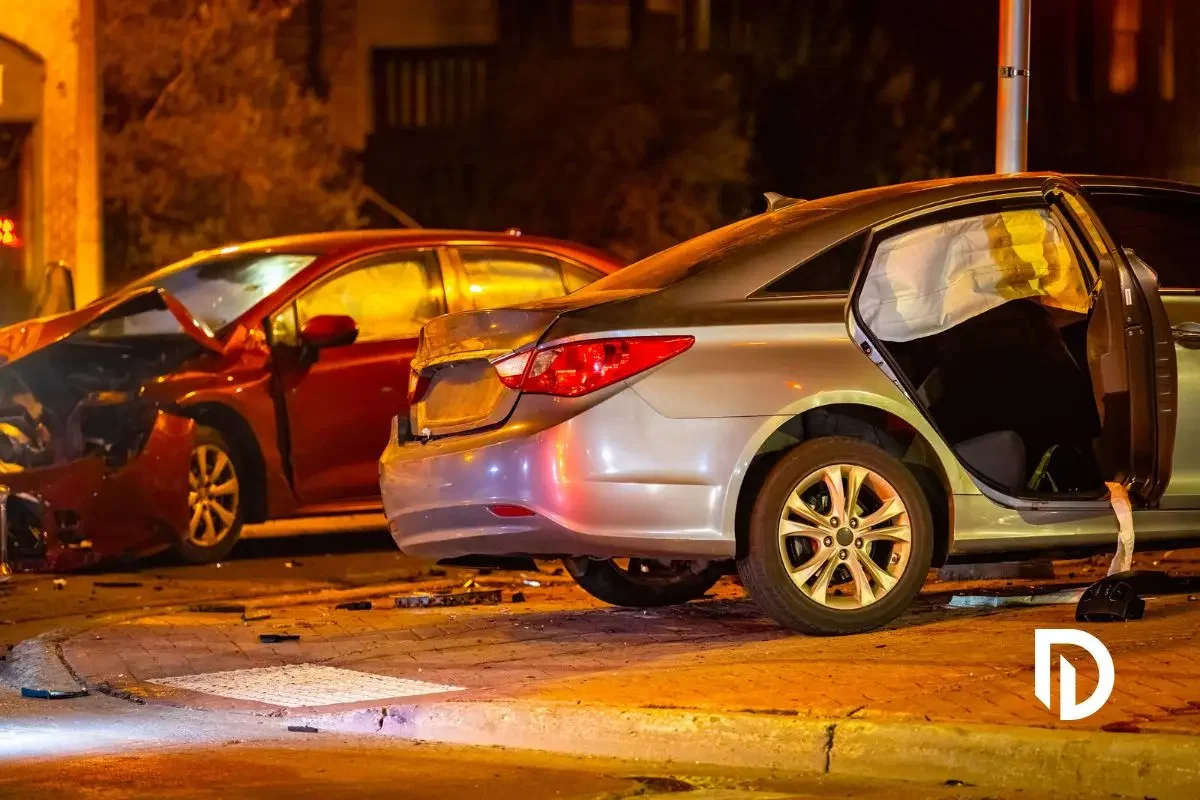
Multi-vehicle crashes are less common than the typical auto collision. However, they can be especially disastrous, causing multiple drivers to be injured. One recent chain-reaction crash that occurred in Beverly, Massachusetts, involved a driver losing control, striking a stop sign, and hitting multiple parked vehicles, ultimately sending multiple people to the hospital with injuries.
In these scenarios, victims often experience immediate confusion about how the crash unfolded and uncertainty about who is legally at fault. It can be an overwhelming task to navigate injuries, vehicle damage, and insurance claims. Fortunately, our trusted car wreck attorneys can step in and help you recover physically and financially. Contact DiBella Law Injury and Accident Lawyers today to learn more about your legal options with a free case evaluation.
How Is Fault Determined in a Chain Reaction Car Accident?
Determining who is at fault for an auto collision always stems from the principle of negligence. There are four elements of negligence in law: duty of care, breach of duty, causation, and damages. Every driver on the road has a duty of care to operate their vehicle safely, avoiding harm to others.
When someone fails to fulfill this duty, it is considered a breach. For example, a distracted driver who causes an accident while texting can be held liable for the resulting damages. Causation is the clear link between the liable party’s actions and the victim’s damages. The harm resulting from an accident must result in compensable damages, such as medical bills, repair costs, and emotional distress.
One of the most challenging liability scenarios we see involves “sandwich” collisions—when a middle vehicle is struck from behind and forced into the car ahead. While the rear driver is often presumed at fault, these crashes frequently raise complex liability questions. The lead driver may have stopped abruptly, the rear driver may have been following too closely, or dangerous road conditions may have contributed to the chain of events.
Because these crashes unfold in seconds and often involve multiple points of impact, victims in the middle vehicle are frequently left facing serious injuries like whiplash and concussions, significant vehicle damage, and aggressive insurance investigations, all while trying to determine which driver, or combination of drivers, should be held legally responsible for compensating them.
Who Can Be at Fault in a Chain Reaction Car Accident?
Due to the complexity of these types of collisions, shared or partial fault may be a factor. The first crash does not automatically determine liability, and several parties may share fault, including the following individuals:
- The driver who caused the initial impact due to distracted driving, speeding, or tailgating
- Drivers who failed to maintain a safe distance, even if they were not the first to collide
- Multiple drivers due to combined negligence
- Third parties who are responsible for poor road design, missing signage, and hazardous road conditions
- Employer of commercial truckers and other vehicles
- Pedestrians and bicyclists
Some Chain-Reaction Car Accident Scenarios
While less common, chain car accidents are very real and very dangerous. One of the most severe chain-reaction scenarios occurs when a driver enters an intersection unlawfully or at high speed, triggering multiple impacts across lanes of traffic.
For example, in a Reading, Massachusetts, crash, investigators reported a driver allegedly ran a red light, struck another vehicle, and caused it to spin into additional traffic, creating a multi-vehicle crash that left one person dead and others injured.
However, chain reactions do not only happen at highway speeds. Even low-speed environments can turn dangerous when a vehicle loses control. In Beverly, emergency crews responded after a driver’s accelerator reportedly became stuck, causing the vehicle to strike a stop sign and then crash into multiple parked cars, sending four people to the hospital and leaving several vehicles totaled.
Some chain reactions begin with a single impact but escalate when vehicles strike objects and then continue into other cars or structures. In Brockton, a chain-reaction crash ended with a vehicle striking a rock, then a parked car, then a utility pole, and finally crashing into a house.
In one case our team took on, we helped secure compensation for a passenger injured in a rear-end collision involving multiple vehicles. Rear-end chain reactions are among the most common scenarios, especially in traffic congestion or sudden slowdowns. Similarly, our firm helped an injured victim recover compensation after a serious multi-vehicle crash that caused extensive damages.
Evidence Needed To Prove Fault in Chain Reaction Crashes
Different types of liability can arise from a chain-reaction accident. At DiBella Law, our hardworking lawyers know how to follow each unique process to prove fault and secure compensation. Depending on the circumstances, liability in a chain-reaction crash may involve one or more—or none—of the following parties:
- Another driver: In most cases, one or more drivers are to blame for the collision. This could be due to distracted driving, speeding, or other negligent behavior. In these instances, our team can help collect evidence to prove fault and file a case.
- Government entities: The government may be responsible for a crash caused by dangerous road conditions or a traffic control failure. We can comply with the special rules that apply to these types of cases, such as strict notice deadlines, damage caps, and filing procedures.
- No one is liable: Because Massachusetts is a no-fault state, injured drivers typically first seek compensation through their own Personal Injury Protection (PIP) coverage, regardless of who caused the crash. However, if injuries meet the state’s serious injury threshold, victims may pursue additional compensation from the at-fault party.
How Insurance Companies Handle Chain Reaction Car Accidents
Multi-vehicle accidents typically require extensive investigation, and with multiple insurance companies involved, the claims process can become slow and complicated. Insurers may initially assign partial fault, but those determinations often shift as additional evidence comes to light. Acting quickly to speak with a law firm is critical to protecting your rights, managing the legal process, and helping prevent insurance companies from pushing low settlement offers.
What Happens if One or More Drivers Are Uninsured?
Uninsured drivers are not uncommon in multi-vehicle accidents and do not automatically prevent someone from pursuing a claim. Uninsured/underinsured motorist (UM/UIM) coverage is protection built into your own auto insurance policy that can help pay for your injuries and losses if the at-fault driver either has a lack of or no insurance to cover damages.
These situations are generally more complex, often involving multiple policies and investigations. Working with a highly skilled lawyer can help navigate the process. Speak with the DiBella Law team today to better understand your options and protect your rights.
How Our Car Accident Lawyers Help You Secure Compensation
Recoverable damages in Massachusetts include medical bills, lost wages, pain and suffering, property damage, and future care needs. However, you must prove that you suffered each loss to secure compensation for it.
Our dedicated attorneys have the experience needed to build compelling evidence in your case and negotiate with insurers. If you or your loved one has been injured in a chain reaction car accident, do not hesitate to contact our team. Call us at (978) 396-2464 to schedule a free consultation.